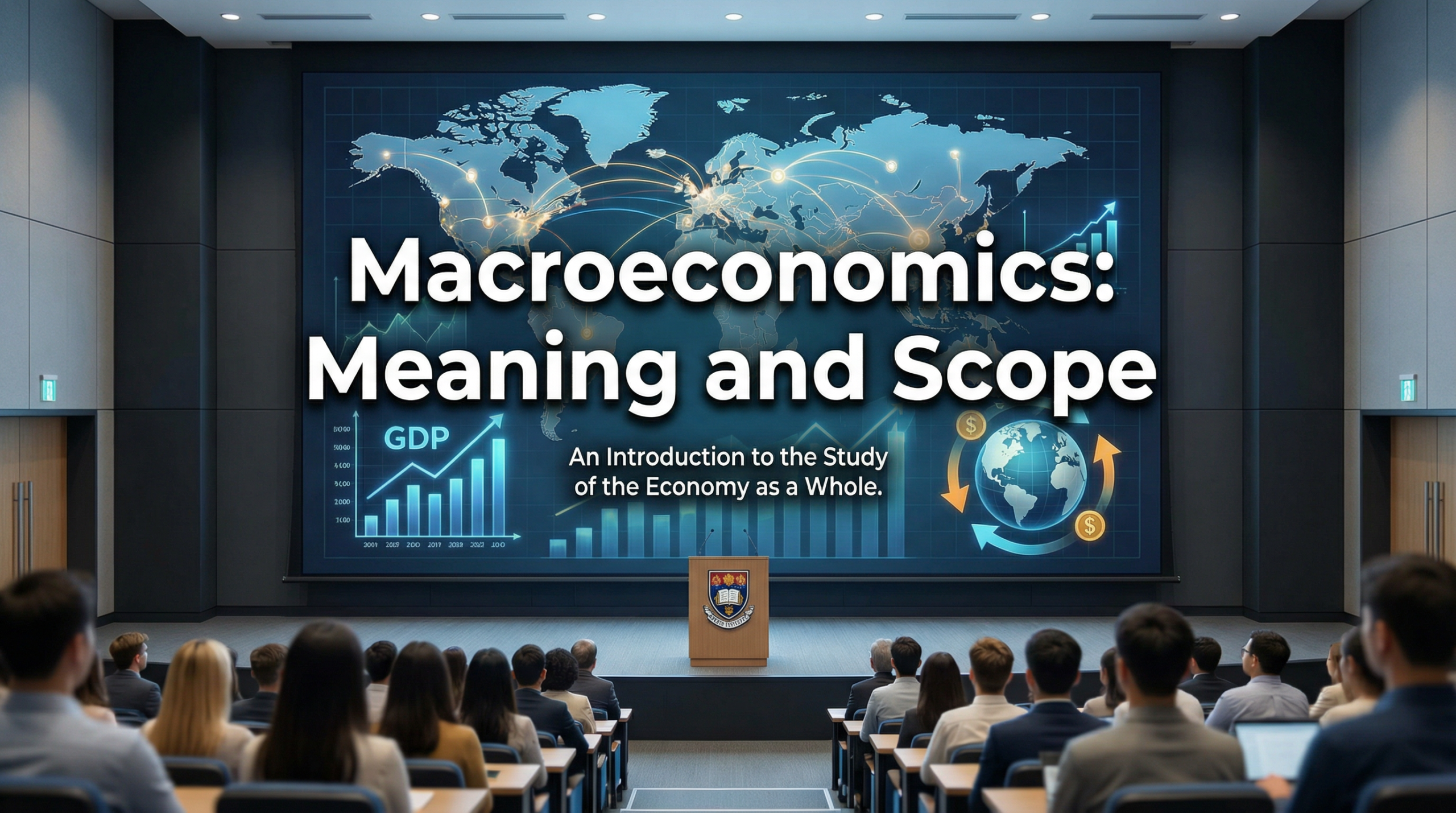
The term “Macroeconomics” is derived from the Greek word Makros, which means “large.” Ragnar Frisch, the Norwegian economist and first Nobel Laureate in Economics, first coined the terms “micro” and “macro” in 1933.
However, the discipline, as we know it today, was born out of the Great Depression. Before the 1930s, classical economists believed that markets would always fix themselves. However, when the world economy collapsed, John Maynard Keynes published his seminal work, The General Theory of Employment, Interest and Money (1936). Keynes argued that the economy could get stuck in a rut and that the government had a role in lifting it out. This marked the beginning of modern macroeconomics.
Meaning of Macroeconomics
Macroeconomics is a branch of economics that studies the behavior and performance of an economy as a whole. It focuses on aggregate changes in the economy, such as unemployment, growth rate, gross domestic product (GDP), and inflation.
If Microeconomics is the study of the “parts,” Macroeconomics is the study of the “whole.”
Microeconomics vs. Macroeconomics: The Core Differences
To fully grasp the meaning and scope of macroeconomics, it is essential to contrast it with microeconomics. Although they are interdependent, their methods and objectives differ.
| Basis | Microeconomics | Macroeconomics |
|---|---|---|
| Level of Study | Individual units (consumers, firms, markets) | Entire economy (nation, world) |
| Focus | Price determination in single markets | National income, inflation, unemployment, growth |
| Key Variables | Demand & supply of one good, elasticity | GDP, CPI, unemployment rate, fiscal deficit |
| Policy Tool | Competition policy, pricing | Monetary policy, fiscal policy |
| Example Question | Why did the iPhone prices fall? | Why did India’s fiscal deficit cross 9% in 2020–21? |
Scope of Macroeconomics
The following six major pillars define the scope of this study:
A. The Theory of National Income
The most significant aspect of macroeconomics is the calculation of National Income. This involves measuring the total value of goods and services produced by a country (GDP, GNP, and NNP). Macroeconomics analyzes how national income is generated, distributed, and fluctuates over time. It helps us answer the question of whether a country is getting richer or poorer.
B. The Theory of Employment
Why are people out of work? The classical view is that unemployment is voluntary or temporary. Keynesian macroeconomics, however, analyzes “involuntary unemployment.” The scope of macroeconomics includes understanding the relationship between aggregate demand, aggregate supply, and the level of employment in an economy.
C. The Theory of Money and General Price Level (Inflation)
Macroeconomics does not consider the price of an iPhone. It looks at the General Price Level. It studies:
- Inflation: A persistent rise in the general price level.
- Deflation: A persistent decrease in prices.
- Monetary Policy: How the Central Bank (such as the Federal Reserve or RBI) manages the money supply to keep prices stable.
D. The Theory of Economic Growth
While short-term macroeconomics deals with business cycles (booms and recessions), long-term macroeconomics focuses on Economic Growth. This part of the scope analyzes how an economy increases its production capacity over the decades. It involves the study of capital accumulation, technological progress and population growth.
E. The Theory of International Trade (Open Economy Macroeconomics)
No country is an island (economically). The scope of macroeconomics extends to the interactions between nations. This includes:
- Balance of Payments: Tracking all monetary transactions between a country and the rest of the world.
- Exchange Rates: How the value of a currency is determined.
- Tariffs and Trade Policies: How exports and imports affect the domestic economy.
F. The Theory of Business Cycles
Economies naturally fluctuate over time. There are periods of prosperity (boom), followed by downturns (recession) and recovery. Macroeconomics attempts to analyze the causes of these fluctuations and suggests policies to smooth out the ride, preventing deep depressions or hyperinflation in the economy.
Importance of Macroeconomics
1. Formulation of Economic Policies
Governments rely on macroeconomic analysis to create Fiscal Policy (taxation and spending) and Monetary Policy (interest rates). Without macroeconomics, the government would be flying blind, unable to fight recessions or to control inflation.
2. Understanding Economic Fluctuations
Why did the 2008 Financial Crisis occur? Why did inflation spike after post-COVID-19? Macroeconomics provides analytical tools to diagnose these issues and create remedies.
3. International Comparison
How do we know if China’s economy is growing faster than the USA? Macroeconomic indicators, such as GDP and Purchasing Power Parity (PPP), allow us to compare standards of living across different nations.
4. Business Decision Making
Even CEOs require macroeconomics. If macro analysis predicts a recession, businesses might pause their expansion plans. If it predicts high inflation, a business may stock up on raw materials.
Evolution of Macroeconomic Thought
| Period | School / Event | Key Ideas |
|---|---|---|
| Pre-1930s | Classical School | Markets are self-correcting; there is minimal or no role for government intervention. |
| 1936 | Keynesian Revolution | Active fiscal and monetary policies are required to manage demand and stabilize the economy. |
| 1960s–1970s | Keynesian Dominance | Governments attempt to “fine-tune” economic cycles using discretionary policies. |
| 1970s | Rise of Monetarism | Stagflation leads to Monetarist critique; Friedman’s dictum: “Inflation is always and everywhere a monetary phenomenon.” |
| 1980s | New Classical School | Rational Expectations, market-clearing models, and the Lucas Critique challenge traditional policy effectiveness. |
| 1990s | New Keynesian Economics | It incorporates micro foundations, sticky prices, menu costs, and supports rules-based policy. |
| Post-2008 | Return of Keynesian Ideas | Fiscal stimulus, quantitative easing (QE), and zero (or negative) interest rate policies have gained prominence. |
| 2020s | MMT Debate & Fiscal Dominance | Increased interest in Modern Monetary Theory (MMT), large fiscal deficits, and supply side-driven inflation dynamics have been observed. |
Limitations of Macroeconomics
While the scope of macroeconomics is wide, the discipline is not without faults. As a student, you must be critical of the theories that you learn.
- The Fallacy of Composition: As mentioned earlier, what works for an individual does not always work for the economy. If one person saves money, they become rich. If everyone saves money, demand drops, and the economy crashes (Paradox of Thrift).
- Aggregation Issues: Macroeconomics deals with “aggregates” (averages). Sometimes, the average data hide the reality. For example, a country might have a high GDP growth, but if that wealth is concentrated in the hands of 1% of the population, the “average” person is still poor.
- Lag Effects: Macroeconomic policies (such as cutting interest rates) take time to work. By the time a policy takes effect, the economic situation may have already changed.
Conclusion
In summary, the meaning and scope of macroeconomics encompass the study of the economy in its entirety. From the Great Depression to modern digital currencies, macroeconomics has evolved to help us understand the complex machine that is the global marketplace.
For undergraduate students, mastering the scope, which ranges from national income and employment to inflation and international trade, is essential. It provides a framework for understanding not only how to run a business but also how the world operates.
As you progress in your studies, remember that macroeconomics is not an exact science, like physics. It is a social science that is constantly evolving as human behavior and global politics change.