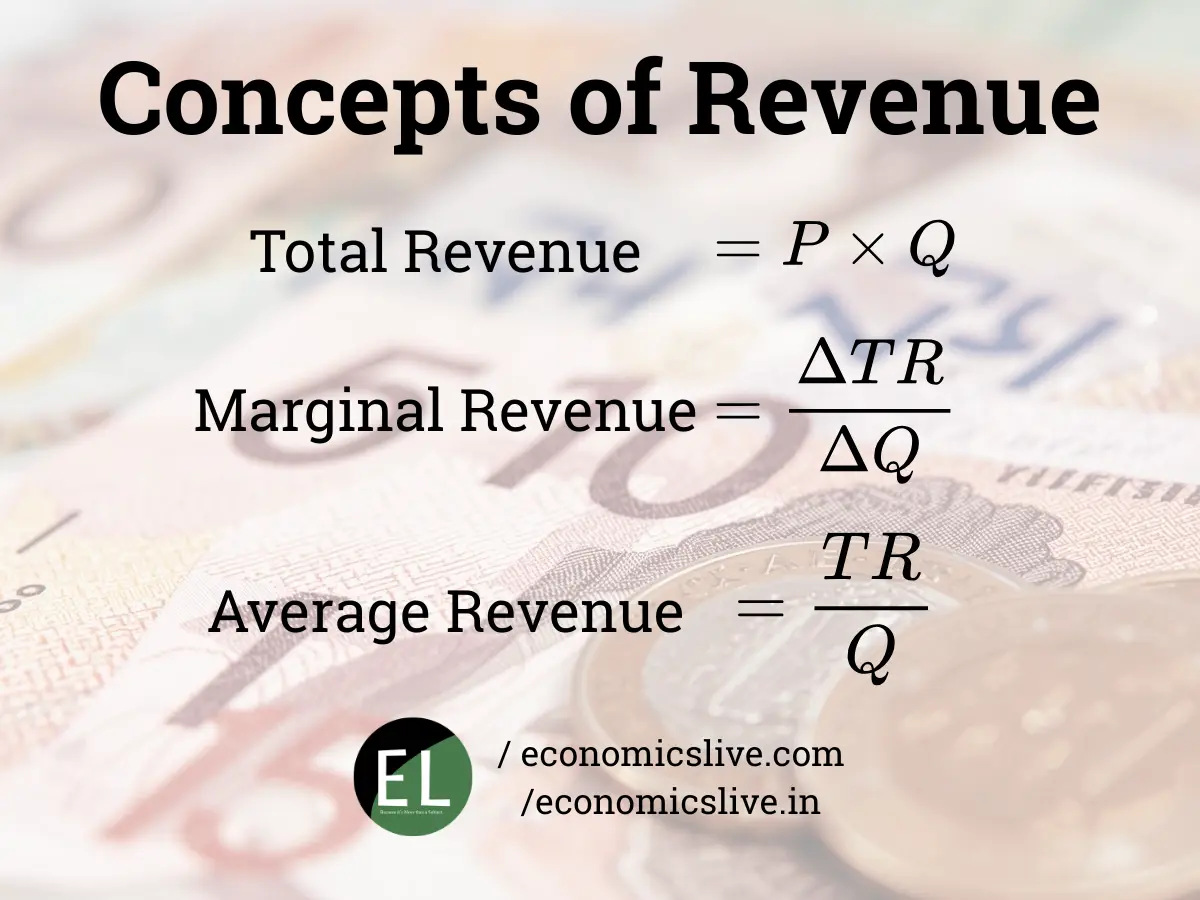
In economics, revenue refers to the total amount of money a firm receives from the sale of its goods or services. To understand how a firm maximizes profit, we must analyze three key concepts: Total Revenue (TR), Average Revenue (AR), and Marginal Revenue (MR).
Total Revenue
Definition: The total income earned by a firm from selling a given quantity of output.
Formula:
where:
= Price per unit
= Quantity sold
Example: If a firm sells 100 units at ₹50 each, .
Average Revenue
Definition: It is revenue earned per unit of output sold.
Formula:
(Since under perfect competition, where price is constant)
Example: If for 100 unites, .
Key insight:
In Perfect Competition, (price is constant)
In Imperfect Competition (e.g., monopoly), declines as output increases because the firm must lower prices to sell more.
Marginal Revenue
Definition: Additional revenue earned from selling one more unit of output
Formula: , i.e., Change in total revenue as quantity changes.
Example: If selling the 101st unit increases , from to , then .
Key insight:
In Perfect Competition, (since price is constant).
In Imperfect Competition, (because the firm must reduce price to sell more, affecting all units).