
We have seen the definition of Indifference Curve. Now we will discuss the the properties of Indifference Curve.
Property 1: Indifference Curves are Downward Sloping (Negative Slope)
An Indifference Curve always slopes downward from left to right, meaning it has a negative slope.
If the consumer gets more of Good X, they must give up some of Good Y to remain at the same level of utility. If both goods increase, utility would increase; which means moving to a higher Indifference Curve, not staying on the same indifference curve.
Mathematical Proof:
We know that along an IC, utility is constant:
Taking the total differential:
Solving:
By the assumption of non-satiation (more is better):
Therefore:
This confirms that the slope of Indifference Curve is negative i.e., it confirms that Indifference Curve is downward sloping.
Exception: If one of the goods is a “Bad” good i.e., something the consumer dislikes, then the Indifference Curve could be upward sloping. But in standard analysis, we deal with goods, so Indifference Curve is downward sloping.
Property 2: Higher Indifference Curve Represents Higher Level of Utility
A consumer always prefers a higher indifference curve to a lower one because higher Indifference Curve represents more utility.
Let there are two Indifference Curves  and
and  :
:

 where
where 
Consider two points:
Point A on  with
with 
Point B on  with
with 
Since :
By the assumption of monotonicity (more is better), a bundle with more goods is preferred.
If we take a point  that lies to the upper right of point
  , meaning
  and
and  (at least one strict), then:
Higher Indifference Curve = More Satisfaction = More Preferred
Property 3: Indifference Curve Never Intersect Each Other
Two Indifference Curves cannot cut or intersect each other.
This is one the most important properties, and it follows from the logic of consistency and transitivity of preferences.
Mathematical Proof (by contradiction):
Suppose  and
and  , where
  intersect at point
  .
.
Let:
Point = Intersection point (on both , and )
Point  = on only
Point  = on only
From  Both and give the same utility:
From  Both and give the same utility:
From  and
and  :
:
But this means and give the same utility, which means and should be on the same indifference curve.
However, we said is on (higher IC with more goods/higher utility) and is on .
If has more of at least on e good than (which it does since it’s on a higher IC), then:
This contradicts our result that  .
.
Contradiction! which implies and cannot intersect
This proves that indifference curves can never intersect.
Property 4: Indifference Curves are Convex to the Origin
An Indifference Curve is convex to the origin, which means it is “bowed inward” toward the origin. This is due to the Diminishing Marginal Rate of Substitution (DMRS).
When a consumer has a lot of Y and little X, they are willing to give up more units of Y to get some one more unit of X. But as the consumer gets more and more of X, they become less willing to give up Y. This declining willingness to substitute is called Diminishing MRS.
Mathematically;
A curve is convex to the origin if its second derivative is positive:
We know that;
For convexity (diminishing MRS):
This means as X increases, MRS falls:
In case of Cobb-Douglas Utility Function:
Since Y decreases as X increases along IC ( ), the ratio
  falls as X increases:
Therefore:
Special Cases
| Shape of IC | Type of Goods | MRS |
| Convex (Normal Shape) | Normal Goods (Imperfect Substitutes) | Diminishing |
| Straight Line (Linear) | Perfect Substitutes | Constant |
| Right Angle (L-Shaped) | Perfect Complements | Zero (Kinked) |
| Concave | Goods with increasing MRS | Increasing (Unusual) |
Property 5: Indifference Curves Do Not Touch the Axes (Generally)
In standard analysis, an Indifference Curve does not touch either axis because we assume the consumer consumes positive quantities of both goods.
The domain of the Indifference curve is:
If the indifference curve touches the X-axis, Y = 0, meaning the consumer consumes none of good Y, which violates the assumption that both goods are needed to give utility (as in Cobb-Douglas where  ) if Y = 0.
There is an Exception: If goods are perfect substitutes, the Indifference curve is a straight line that can touch both axis.
Property 6: Indifference Curves are Smooth and Continous
Indifference Curves are drawn so smooth, continuous curves assuming that goods are perfectly
The utility function  must be:
1. Continuous i.e., no sudden jumps.
2. Differentiable i.e., partial derivatives  and
and  must exist.
This ensures that 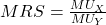 is defined at every point along the curve.
All the properties can be summarized in a table below:
| Property | Statement | Mathematical Condition |
| Downward Sloping | IC has negative slope | 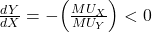 |
| Higher IC = Higher Utility | Upper IC is preferred |  |
| ICs Never Intersect | No two ICs can cross | By contradiction and transitivity |
| Convex to Origin | Bowed inward shape |  , DMRS , DMRS |
| Do Not Touch Axes | Consumer needs both goods |  |
| Smooth and Continuous | No kinks or breaks |  |