What is Scarcity
CORE DEFINITION
Scarcity is the fundamental economic condition in which human wants and needs are infinite, while the resources available to satisfy those wants are finite i.e., making it impossible to fulfil all desires simultaneously.
Scarcity is not merely a condition of poverty or underdevelopment; it is a universal economic reality that confronts every individual, firm, and government, regardless of wealth or geography. Even in the most affluent economies, time, land, skilled labor, and capital are available only in limited quantities.
At its core, the study of economics is the study of how societies manage scarcity. As Paul Samuelson defined economics, it is “the science of choice under scarcity.” Every economic decision, from a student choosing between two courses to a government allocating a national budget, is a direct consequence of scarcity.
“The first lesson of economics is scarcity: there is never enough of anything to fully satisfy all those who want it.”
– Thomas Sowell, economist and author
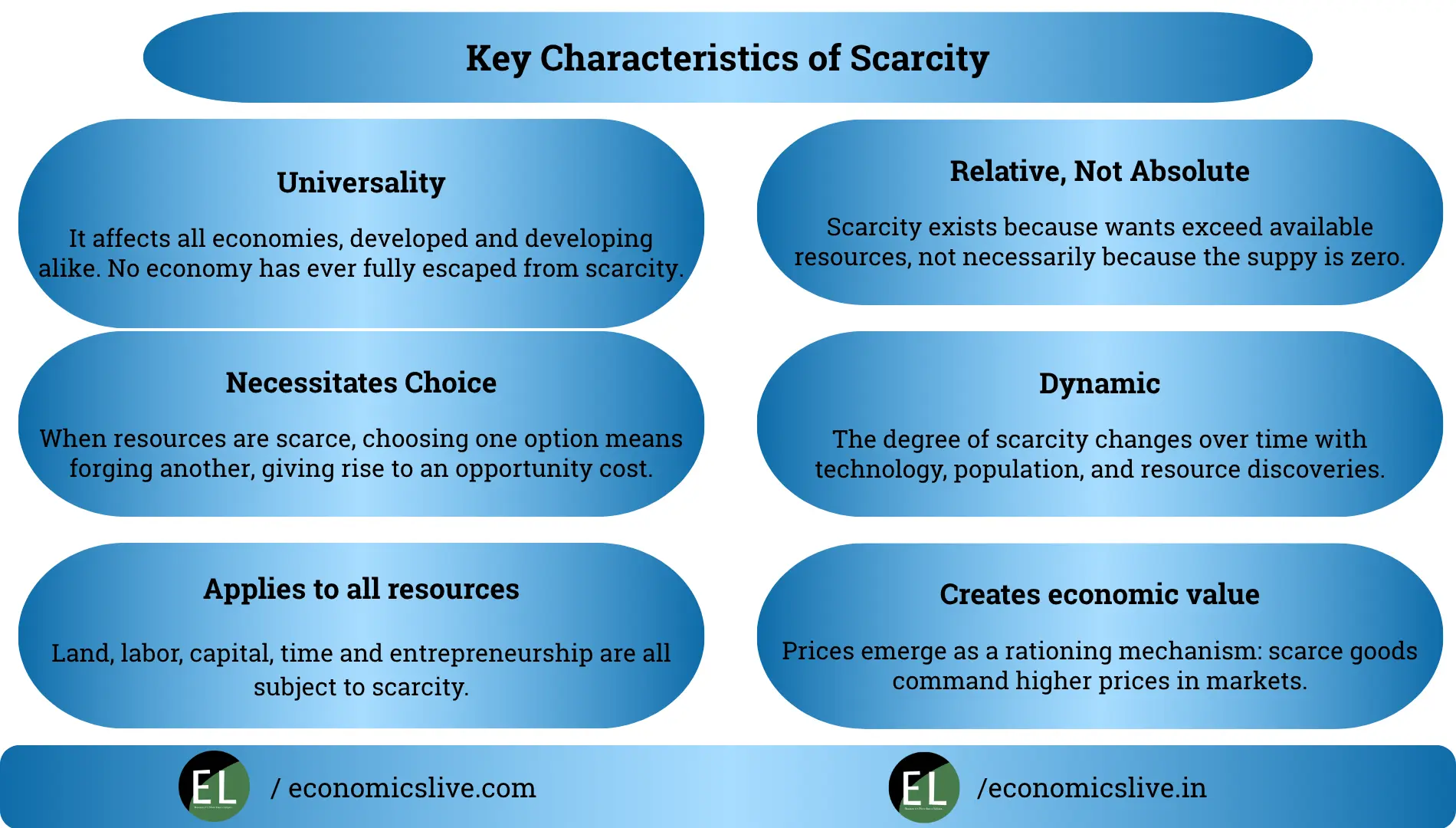
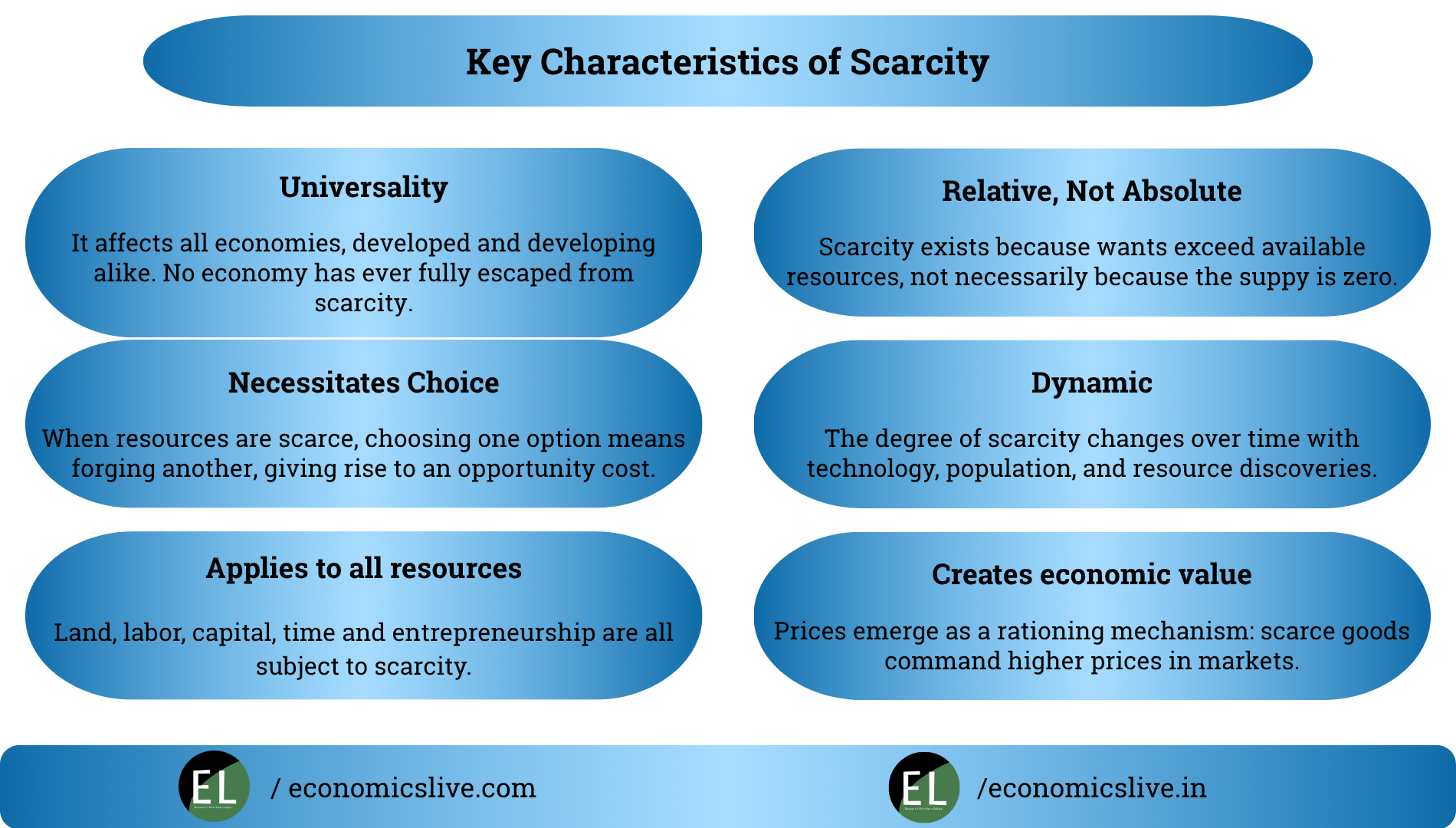
Key Characteristics of Scarcity
Types of Scarcity
| Type | Description | Example |
| Demand – Induced | Rising demand outpaces available supply | Housing in Mumbai and New York City |
| Supply – Induced | A natural resource is depleted or dwindling | Groundwater depletion in Punjab, India |
| Structural | Inequitable distribution causes some to lack access even when aggregate supply exists | Food insecurity amid surplus agricultural production |
| Absolute Scarcity | Total global supply of a resource is finite and exhaustible | Fossil fuels, rare earth minerals |
| Relative Scarcity | Supply is insufficient relative to current demand levels | Semiconductors during the 2021 – 22 global chip shortage |
Scarcity vs Shortage – A Critical Distinction
We often conflate these two terms. It is important to note the distinction clearly for examination purposes.
CONCEPTUAL CLATIRY
Scarcity is permanent, inherent condition; resources are always limited relative to unlimited wants. It cannot be “solved”. On the other hand, a shortage is a temporary market condition in which the quantity demanded exceeds the quantity supplied at the prevailing price; it can be resolved through price adjustments or policy intervention.
For instance, petrol during a natural disaster may be in short supply (a shortage) but petrol as a fossil fuel is inherently scarce regardless of price. The former is a market disequilibrium, and the later is a fundamental resource constraint.
Case Study (India)
Chennai Water Crisis and Bengaluru’s Day Zero
In 2019, Chennai, a city of 9 million, experienced near-complete depletion of its reservoirs, forcing hotels, restaurants, and businesses to shut down. In 2024, Bengaluru faced a “Day Zero” scenario, a term describing when a city’s water taps run dry, driven by unprecedented heat and failed monsoons. According to Word Bank, water scarcity could reduce India’s GDP by up to 6% by 2050. Critically, a lack of water to cool thermal power plants between 2017 and 2021 already resulted in 8.2 terawatt-hours of lost energy, enough to power 1.5 million households for five years.
Land Scarcity in Agriculture
India has the most arable land in the world; however, agricultural productivity lags significantly behind its potential. Agriculture accounts for 18.4% of the GDP and employs over 45% of the workforce. Despite this, crop yields per unit are, although improved since 1950, remain considerably lower than global benchmarks. The Economic Survey 2024-25 highlights that agricultural income has grown at 5.2% annually over the past decade, versus 6.2% for non-agricultural sectors, reflecting the continued scarcity of productive agricultural inputs such as quality seeds, water, and soil health.
Structural Scarcity: Labour and Human Capital
India’s labor market also illustrates structural scarcity. With approximately 26% of the population aged 10-24 years, the country possesses a demographic dividend, a large young workforce. However, the scarcity of quality employment and vocational training means that this resource remains underutilized. The 2025 Periodic Labour Force Survey (PLFS) shows improvements in labor force participation; however, the challenge of converting demographic potential into productive output persists, which is a textbook example of structural scarcity.
Case Study (United States)
US Urban Land Scarcity and the Housing Crisis
The United States has vast land, yet land scarcity in economically productive urban zones i.e., Silicon Valley, New York and Boston which has driven median home prices to extraordinary levels. The core constraint is not the total land area but land in proximity to employment, infrastructure, and services. Zoning restrictions further transform relative scarcity into an artificial one. This is a prime example of demand-induced and structurally reinforced scarcity operating simultaneously in the same region.
Semiconductor and Rare Earth Scarcity
The 2021-2022 global semiconductor shortage, which hit American automakers and electronics manufacturers with production halts valued at hundreds of billions of dollars, illustrated how supply chain concentration can transform a relative scarcity into a crisis. The United States holds limited domestic reserves of rare earth minerals essential for clean energy technology and defense, making it a case of absolute scarcity with significant geopolitical implications.
Time Scarcity
Economists are increasingly focusing on time as a scarce resource in high-income economies. In the United States, the rise of dual-income households, longer working hours, and the gig economy have made time i.e., the one resource perfectly equal across all individuals which is a critical economic constraint shaping the demand for convenience services, childcare, and remote work infrastructure. This is a distinctly modern dimension of scarcity that classical economics does not foreground.
The Economics of Choice: Opportunity Cost and Trade-Offs
Scarcity compels choices. Every allocation of a scarce resource involves forgoing the next best alternative; this foregone alternative is the opportunity cost. The production possibilities frontier (PPF) is a standard diagrammatic tool used to represent this trade-off.
OPPORTUNITY COST
The value of the best alternative forgone when making an economic choice. If India allocates additional land for industrial use, the opportunity cost is the agricultural output, biodiversity, or water recharge lost from that land.
From a macroeconomic standpoint, scarcity underpins the three fundamental economic questions that every society must answer:
What to produce?
Which goods and services should scarce resources be allocated to? Consumer goods versus capital goods?
How to produce?
Which combination of scarce inputs — labor, capital, and land — should be used to minimize costs?
For whom to produce?
How are the outputs of scarce resources distributed across different segments of society
Policy Response to Scarcity
Market Mechanisms
In market economies, price signals are the primary tools for managing scarcity. Rising prices signal producers to increase supply and consumers to economise, functioning as a self-correcting mechanism described by Adam Smith’s “Invisible hand”. However, market failures, including externalities and public goods, can result in inefficient resource allocation even when prices are functional.
Government Intervention
Government respond to scarcity through taxation, subsidies, rationing, and direct provision. India’s Jal Jeevan Mission (2019), a ₹3.6 trillion programme to provide piped drinking water to every rural household, and the Jal Shakti Abhiyan targeting all 740 districts are direct policy responses to water scarcity. In the United States, the CHIPS and Science Act (2022) allocated $52 billion to address semiconductor scarcity through domestic manufacturing incentives.
Technological Innovation
Technology can expand the effective supply of scarce resources. Desalination of seawater, precision agriculture, renewable energy, and digital infrastructure all serve to relax binding constraints. However, technology itself is a scarce resource, as it requires capital investment, skilled labor, and time to develop and deploy.
Conclusion
Scarcity is the bedrock upon which all economic theories are constructed. It is universal, permanent, and experienced differently across geographies, income levels and resource endowments. India’s water crisis and the US semiconductor shortage both illustrate that scarcity operates through demand pressures, supply constraints, structural inequities, and policy gaps, often simultaneously.
Understanding scarcity is not merely an academic exercise. It is the lens through which every government budget decision, corporate investment, and individual career choice can be interpreted. In a world of finite resources and expanding aspirations, particularly as India targets developed-nation status by 2047 and the US navigates clean energy transitions, intelligent management of scarcity will define economic outcomes for generations.