This Cobb-Douglas production function is based on the empirical study of the American manufacturing industry made by Paul H. Douglas and C.W. Cobb. It is a linear homogeneous production function that considers only two inputs, labor and capital, for the total output of the manufacturing industry. The Cobb-Douglas production function is

Where,
 Output
 labor
labor
 Capital
 Positive Constants
Properties of Cobb Douglas Production Function
The Cobb-Douglas production function has some interesting mathematical properties, which make it very useful for managerial decision-making. The important properties are the following:
1. The marginal product of capital and labor depends only on the quantities of capital and labor used in the production process. The equation for the marginal product of capital is given by:





 or
or 

Where,  = the average product of capital
Similarly, the equation for the marginal product of capital is given by,






 or
or 
It is to be noted here that  and
and  both are positive but constantly diminishing.
2. The Marginal Rate of Substitution
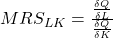


3. Thirdly,  and
and  the exponents of L and K respectively, show the output elasticities of labour (
 ) and capital (
 ).
).
For , the percentage rise in  for 1% rise in
  will be


In terms of partial derivatives, we can write,


Similarly,


Hence if  0.5 then 1% rise in the amount of labour used (keeping labour constant) will rise output by 0.5%.
4. The Cobb-Douglas Production function can be extended easily to more than two inputs e.g., capital and labour, natural resources, non-production labour, etc.
5. The Elasticity of substitution


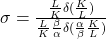

Hence, such a production function has the elasticity of factor substitution is equal to one.
6. Factor Intensity — In a Cobb-Douglas function factor intensity is measured by the ratio  . The higher this ratio the more labour intensive the technique. Similarly the lower the ratio the more capital intensive the technique.
7. The sum of the two exponents ( and ) shows returns to scale. In the Cobb-Douglas case the returns to scale can be predicated as follows —
a) When  the production function exhibits constant returns to scale,
b) When  , it exhibits increasing returns to scale, and
c) When  , it exhibits decreasing returns to scale.
Let us take the Cobb-Dauglas function i.e.,
and multiple each input by the factor  . So we get,



