A change in the price and income alters the consumer’s expenditure pattern. So to know the consumer’s expenditure pattern due to changes in price and income, all the variables should be varied simultaneously.
Let,
Utility function be 
Subject to 
Or 
Here we can form a new function with the help of langrange multiplier i.e.,

First-order derivatives can be written as:



Now we can know the effect by total differentials of the above equations:
So,



Now it can also be rewritten as :



Here the unknown are 
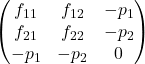
 =
= 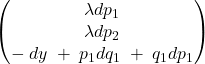
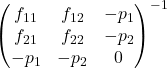
Now, the first matrix contains the same element as the bordered Hassian determinant. The solution can be done by the Cramers Rule. Their rule is as follows: if AB = C, then B = A-1C. But before applying the Cramers Rule, let us denote the determinant as D and the cofactor with their respective subscripts.
= 
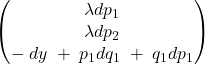
Also,
= 
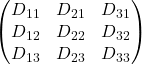
Solving the above equations for :



Now, consider  and divide both sides by

Income Effect
The left-hand side of equation (A) shows the partial change in quantity q1 due to change in price. Similarly, we can calculate the effect of income.
Income effect corresponds to  which can now be obtained by dividing the equation by
  . Keeping price as constant.
So,  changes to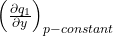
So, = 
Substitution Effect
Change in the commodity price may take consumer to some other indifference curve. Consider that the price change is compensated by the change in income, so that the consumer remains on the same indifference curve.
Increase in price is accompanied by increase in income so 
As we know that 
And 
So,  is true and also
So, 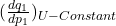 =
= 
Now equation A can be rewritten as
 =
= 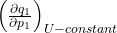 –
– 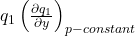
The above equation gives us the rate of change in the purchase of commodity due to change in price in terms of substitution and income effects.